मुझे बताया है उसने मयकशीं बतौर इलाज़-ए-इश्क़ 
मैंने अपना हाल-ए-दिल सब साक़ी को बता रखा है।

रिन्द के रिन्द रहे जो शब-ए-हिज़्र से अब तक सुनें 
बेरहम इस ज़माने में हक़ीक़त के सिवा क्या रखा है। 

लहरों की ललकार को क़ुबूला तो मिली थी नयी दुनिया
साहिल से तूफाँ का नज़ारा करने में बता क्या रखा है।

पड़ जाये पीना ज़हर तो सुकरात मीरा की मानिंद पी लेना
कहना पड़े तो कह देना ये क्या कि दिल में छुपा रखा है। 

जुनून कब हारा है कहाँ किसी ख़तरे से बता तू यायावर
आप ही आप मन में तूने खुद को नातवाँ बना रखा है।


रिन्द - drunk
शब-ए-हिज़्र - night of separation
साहिल - shore
मानिंद - as
नातवाँ - weak 


"The history of all hitherto existing society is the history of class struggles."

Manifesto of the Communist Party, or alternatively Communist Manifesto, is one of the most important document of the communist thought which has guided since then many worker and peasant revolutions. Written in England by German philosophers Karl Marx and Friedrich Engels, who were commissioned by the Communist League, an underground international association of workers, to write a detailed political and theoretical program for the Party. The manifesto was translated into many languages and was smuggled to many countries.
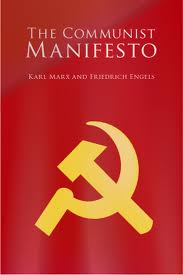
'The Communist Manifesto' by Karl Marx, Friedrich Engels
In this document most of the rhetoric were characteristic of Marx; Engels contributed to main Ideas. So major was the implication of this and other works like 'The Capital' of Marx, that a branch of communism was called Marxism. Although in the preface to many editions written after the death of Marx, Engels said that this Manifesto is the work of Karl Marx, but notwithstanding his modesty, it has been since understood that Engels was a major contributor of this document. Engels provided Marx, a much-needed economic support to write his other works on communism.

This book is divided into four parts. An analysis of the Class Struggle, the first part deals with the relationship between Bourgeois and Proletarians. In appendix, Bourgeois are defined as 'class of modern capitalists, owners of the means of social production and employers of wage labor.' and proletariat as the 'class of modern wage laborers who, having no means of production of their own, are reduced to selling their labor power in order to live.' It is suggested that Capitalism leads to Imperialism. When methods of production improve, there is a surplus and to find new markets for that surplus new territories are conquered. Now having more territories, the capitalist exploit working class more to increase production.

The second part discusses the relationship between the proletarians and communists. It is said that communists work for the interest of working class. The difference between both of them is that Communists work for the common interests in proletarian struggles of different countries. Their only aim is to represent the interests of the movement as a whole. Main ideas of the communists were the abolition of private property, the abolition of the family, the abolition of countries and nationality, the abolition of all rights of inheritance among a host of other ideas. These were the most radical ones, radical even in contemporary society, others were largely implementable in a communist society.

The third part is a critical discussion of then available socialist and communist literature. Reactionary socialism was of three types: Feudal socialism, in which aristocrats supported proletarians because they themselves were against the rise of bourgeois after the French Revolution and English reform agitation, Petty-Bourgeois Socialism, which was similar to Feudal socialism only feudal aristocracy replaced by medieval bourgeois and small peasant proprietors and German Socialism, which was the fight of Germans against feudal aristocracy and absolute monarchy. In Conservative or Bourgeois Socialism, socialist bourgeois wants all the advantages of modern social conditions without its revolutionary and disintegrating elements. Critical-Utopian Socialism and Communism were originally revolutionary ideas but now they are just a reactionary ones and aim at deadening the Class Struggle and reconciling the class antagonisms. Fourth part details the relationship of Communism with the opposition parties in European countries. The book ends with the slogan "WORKERS OF ALL COUNTRIES, UNITE!"

This is a pocket-guide version of the communism theory and like all pocket-books, too many details should not be expected. It works to arouse interest in communist literature and gives a look into the propaganda when too many schools of thoughts were not developed within communism. This document was the major inspiration behind the many communist revolutions in early nineteenth century. The Communist Manifesto is recommended for those who are interested in politico-economic theories and want to know the original thoughts of Karl Marx.


After Jallianwala Bagh and Durgiana Temple, it was time to go to the Indo-Pak border. The Wagah border crossing is the only such crossing between India and Pakistan. The journey of about 30 km from the city of Amritsar to Wagah border took around one hour. The road to Wagah was surrounded by lush green wheat fields, typical of roads in outskirts of cities in Indo-Gangetic Plains. And this was the famous Grand Trunk Road, which enters Pakistan after Wagah border. It runs from Chittagong, Bangladesh to Kabul, Afghanistan. Sher Shah Suri, who occupied the Delhi throne for a brief time, rebuilt greater parts of this road, after which it was known as Sadak-e-Azam or 'the great road.' 

We reached the border well before sunset. The vehicles were stopped few kilometers before and what followed that was walking to the security posts where checks were done. While walking we saw many Pakistani trucks, decorated so heavily and intricately. You will find poetic verses, floral patterns, pictures of local movie actors among many other things. Different regions in Pakistan have different truck arts. So in a way, these trucks represent history and culture of a region. At the end of our walk, we were frisked and then allowed to the go the area near the border.

The sitting area near the border resembled arrangements made in a small stadium. Thousands of people flock from every corner of the country to watch the 'Beating Retreat Ceremony' or 'flag lowering ceremony' everyday. Soon the area was packed with the visitors and few people had to sit on the roadsides. Before ceremony could start there were patriotic songs being played by Border Security Force(BSF), trusted with the security of this border crossing. People even danced on those tunes. There was one BSF personnel asking the audience to respond enthusiastically to patriotic slogans.


Soldiers getting ready for beating retreat ceremony at Wagah Border, Amritsar

Before sunset, the flag lowering ceremony started. Iron gates were opened from both the sides. Soldiers from both sides of the border went towards the gate and stopped at the gate. At the gate, soldiers lowered the flags slowly, rhythmically and in complete synchronization with the other side. There were huge arches built at some distance from the gate on both sides, where flags were being lowered simultaneously. Flags were then folded and the ceremony ended with the only physical contact between two sides - a rude handshake between officers from either side, after which gates were closed again. It was very surprising to find that countries which are seemingly so inimical to each other can do something that looked so coordinated. In fact, it has been described as 'carefully choreographed contempt' by renowned actor and produced Michael Palin who was here to shoot one of his television programs.


Looking at the Pakistan's Gate from India's Gate at Wagah Border


After the ceremony, we marched again towards Amritsar city. We stopped at a roadside Dhaba to taste famous 'Makke di Roti' and 'Sarson da Saag' of Punjab. We also stopped at some factory outlets of clothing chains. And back in the city, the lassi of Amritsar was so awesome and fresh, and a big glass of that at such a reasonable price compared to rest of India. In our first trip to Punjab, we saw the highest seat of Sikh religion and a monument which silently reminds the ruthlessness of  British Raj. We could also look towards the other side of the Radcliffe Line. 

Also, see Amritsar : A photo blog of Flag Lowering Ceremony at Wagah Border. See photos of Jallianwala Bagh and Durgiana Temple on Flickr here.


After visiting Golden Temple, Jallianwala Bagh and Durgiana Temple, we left for the Wagah Border.

en route to Wagah Border

When we reached there, preparations were underway. 


Just after reaching the Wagah Border

People dancing on patriotic tunes at Wagah Border

Soldiers getting ready for beating retreat ceremony at Wagah Border, Amritsar

The beating Retreat ceremony happening now.

security personnel lowering the flag of their respective countries at Wagah Border

From this side to that side.

Entrance to the border gates at Wagah Border

Once the ceremony was over the place wore a deserted look.

The place looked deserted after the flag lowering ceremony, Wagah Border

A picture of Pakistan's Founder and that side of the border.

The view of a gate in Pakistan with Image of Pakistan's Founder

beautiful flower en route to Wagah Border

The other view

Yes, the largest democracy in the world. 
The largest Democracy in the world welcomes you. A billboard at Wagah Border, Amritsar

For those who are interested in the history of Wagah and Atari.

A billboard narrating the history of two small villages, Wagah and Attari

And last, the colorful trucks of Pakistan.

Beautiful trucks from Pakistan with beautiful paintings


Also, see Amritsar : Beating Retreat Ceremony at Wagah Border. See photos of Jallianwala Bagh and Durgiana Temple on Flickr here.


Colonel: [moments before the Amritsar Massacre] Should we issue a warning, sir?
Gen. Dyer: They've had their warning. No meetings.
[pause]
Gen. Dyer: *Fire!*
(from Gandhi(1982), source : IMDB)
After visiting Harmandir Sahib, we went to the Jallianwala Bagh. It is situated at around 300 meters from the main entrance of Harmandir Sahib. Jallianwala Bagh reminds us of our past, of our freedom struggle against British colonialism. For people of our generation who are used to the violent protests everyday on any type of issue, this place reminds us what was it like to stage a peaceful protest or even to assemble peacefully. Such was the tyranny of British Raj that even a gathering on a festive occasion was fired upon. 

On 13th of April, 1919, there was a gathering of people in Jallianwala Bagh on the traditional festival of Baisakhi. At the scheduled time, the meeting started. Nearly an hour after the meeting started, then-Brigadier-General Reginald Dyer arrived there with a small contingent of Gurkha soldiers. Without even a warning Dyer ordered to fire upon the assembly. The Park was surrounded from all the sides by houses and there were narrow entrances which were chained. Only the main entrance was open for passage, which was manned by soldiers firing indiscriminately. There was no way to leave the park and subsequently most of the people died from the resulting stampede. Many of them jumped into a well inside the park to escape from bullets. More than a hundred bodies were recovered later from the well. This incident is known as Jallianwala Bagh Massacre. After the massacre, curfew was imposed in the city due to which wounded could not be taken out of the park to provide medical support and many more succumbed during the night to the injuries. Official sources placed the number of deaths at 379 while unofficial sources claimed that the total number of casualties were more than a thousand.

Jallianwala Bagh, Amritsar


Today the 6.5-acre site is managed by Jallianwala Bagh National Memorial Trust established in 1951. While entering the park, the spot from which bullets were fired could be seen. Looking from there it could be easily deduced that there was no way to escape the bullets other then coming towards the guns and trying to flee from the main gate. The bullet marks on the surrounding walls are encircled and carefully preserved. There are plaques installed near these marks giving details about the location of the bullets. The well in which people jumped to save their life is also a protected monument inside the park. A stone memorial with stone lanterns at its four corners was inaugurated on 13th April 1961. Later on, one eternal flame ("Amar Jyoti") was also installed.


amar jyoti at Jallianwala Bagh, Amritsar

Near the main entrance to the park, there is a small hall in which a short documentary is played on a projector. The short movie gives a detailed account of what happened on that fateful day. Among other things, the documentary had some rare footage and voices of freedom fighters. This emphasized on the much talked-about right to protest peacefully which modern democracies boast of. If people can not protest in a peaceful manner against a decision of the establishment then how it is different from a dictatorship. 

Durgiana Temple, Amritsar

Then we went to Durgiana Temple, which derives its name from Goddess Durga. Built in 1908, this temple is also called Silver Temple because of its carved silver doors and is structurally similar to Golden Temple. Kar Sewa was performed to desilt the tank in 1921, 1975 and 1999. Durga is the main deity of this temple and Lakshmi and Narayan are the two other presiding deities of Durgiana Temple. That is why it is also called Lakshmi Narayan Temple. After visiting this temple it was time to go to Wagah Border to watch Beating Retreat Ceremony.

Also, see Amritsar : Jallianwala Bagh and Durgiana Temple in Pictures. See photos of Jallianwala Bagh and Durgiana Temple on Flickr here.